A Review of 78 Acts of Liberation
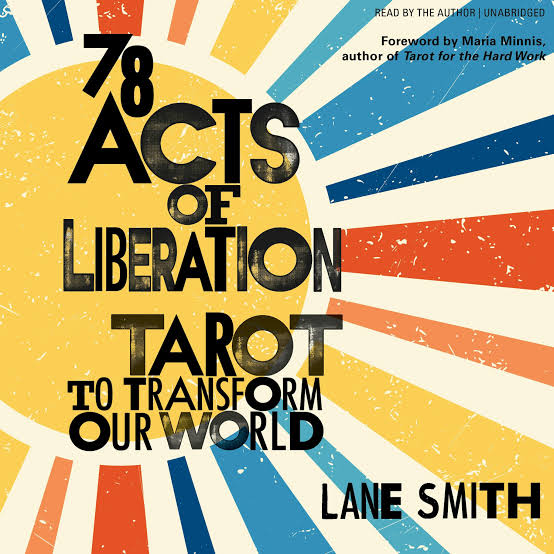
Before listening to the audiobook 78 Acts of Liberation: Tarot to Transform Our World by Lane Smith, I understood how tarot archetypes could connect to larger human experiences. However, I had never explicitly connected each card to social justice movements, collective struggles and practical forms of action.
What fascinated me most was the way Smith connected tarot with historical events and movements, inviting readers to look beyond the individual and consider what the cards can teach us about power, community and liberation.
Tarot has always been more than one thing for me. It can support divination, personal reflection and healing. Smith’s work did not ask me to abandon those purposes. Instead, it expanded them. The book challenged me to consider what becomes possible when we read tarot through a social justice lens, examine power dynamics and ask how the insight we receive might move us toward action.
Smith is a longtime tarot reader, organizer and activist. Their explicitly leftist politics aligned with many of my own beliefs and commitments. As a queer Afro-Boricua woman, educational leader and professor of bilingual education, I have long been deeply connected to social justice. Still, this book offered me a new way to understand movements through the language and structure of tarot.
From Personal Insight to Collective Action
My greatest takeaway from 78 Acts of Liberation was the reminder that liberation requires collective action.
Tarot readings often focus on individual questions: What should I do? What am I not seeing? What do I need to heal? Those questions matter, but our lives do not exist outside history, politics or systems of power. Personal transformation alone cannot remove every barrier confronting us. Sometimes people also need advocacy, community care, mutual aid, organizing and collective resistance.
Smith writes, “Truth alone will not set us free. We have to act on it” (p. 2).
That statement stayed with me. As many of us know in this work, awareness matters, but we can understand that something is unjust and still fail to challenge it. We can recognize our biases while avoiding the systems that reproduce harm. We can receive clarity from the cards and still choose not to act upon what they reveal.
Smith also reminds us that collective action does not require everyone to perform the same role. There will be moments when we can organize, protest or lead, and others when our contribution involves teaching, caregiving, creating, sharing resources or sustaining those doing different work. Liberation is not an individual performance. We are not meant to carry the entire struggle alone.
Literature can remind us what people before us have already resisted, created and accomplished. Those histories can keep us engaged when change feels impossible while asking us to consider what work remains ours to continue.
Forms of Action
One of the book’s greatest strengths in my opinion is its organization. Smith groups the cards numerologically and connects each number to a form of action: initiation, alignment, care, resistance, struggle, repair, adjustment, endurance, realization and generation.
This structure strengthened my understanding of tarot numerology while giving me new language for thinking about how movements develop and survive. Liberation requires more than resistance. It also requires people willing to initiate, align, care, struggle, repair, adjust, endure and create something new.
Smith begins with “The Fool Is a Riot,” connecting the Fool with the risk of shaking things up. Traditionally, the Fool may represent a beginning, a leap of faith or movement toward the unknown. Through a liberation lens, that risk becomes larger than an individual adventure. It can represent the moment people refuse to accept what has been presented as normal and become willing to disrupt it.
This inspired me to think more deeply about how historical events and social movements can be connected to tarot to teach more folx. What might the Major Arcana help us understand about resistance, coalition-building, sacrifice, leadership and collective care? How might the cards help learners enter historical movements through emotion, symbolism and story while still honoring their complexity?
Tarot cannot merely replace historical study or the voices of people who participated in movements. It can, however, become another doorway into learning, one that helps us notice patterns, confront power and connect history to the choices we face today.
Who Is This Book For?
I recommend 78 Acts of Liberation to tarot readers at any level who feel deeply called toward abolitionist, anti-racist and anti-oppressive work. Newer readers may appreciate the practical language Smith provides, while experienced readers may reconsider interpretations they have used for years.
This is not necessarily a light introduction to tarot. Readers who are not actively seeking knowledge as part of their liberation journey may find portions dense. Smith asks us to wrestle with politics, history, power, representation and responsibility. The book requires reflection, but it challenges us not to stop there.
That challenge is precisely what makes it valuable to me as I am actively seeking decolonized ideologies around tarot.
78 Acts of Liberation did not simply give me another collection of card meanings. It gave me another way to ask what tarot is for, to think deeply about how each card talks to one another and what the clarity we receive from it might require of us.
Lane’s work helps ground how reading tarot through a liberation lens means; understanding power, honoring the movements that brought us this far and remaining accountable to the work that is still unfinished. It means asking not only, “What does this card reveal?” but also, “What will I do with what I now know?”
⭐⭐⭐⭐⭐
This review inspired me to give you
A Tarot Spread for Your Liberation Journey
Pull three cards:
- Where am I in my liberation journey right now?
- What is crossing or challenging me?
- What action can I take to move forward?
I pulled the exact spread that I’m recommending…

1. Where am I in my liberation journey right now?
Five of Wands
This makes a lot of sense because when I see the Five of Wands, you immediately think: Is everybody in your circle an ally?
As I enter my mid-thirties, I recognize that not everyone I thought was an ally in my life is necessarily one. No matter other people’s messiness, at the end of the day, I have to really think about my and my families’ inner needs. When I approach conflict, I need to think about the root causes and help those I value in my life see the why before the harm was caused. Then, true repair can begin to be made.
2. What is crossing or challenging me?
The Tower Reversed
Crazy, the Tower reversed. I think that is very representative of all the systems that oppress in society. It also makes me think about how, in many ways, people say the world is on fire when you take the time to watch regional and world news.
It reminds me that whatever you deny, is eventually going to erupt. Don’t hold it all in. Sometimes you don’t think you are necessarily going to fall or that things are going to get to the way they are right now.
When we look at certain pieces of our own liberation as women, transgender, Black, Indigenous and people of color, and queer people, some of those rights are being challenged head-on. We’re in this moment, and even though the Tower reversed scares people, it also reminds me that there is always possibility to rebuild stronger than ever.
3. What action can I take to move forward?
Page of Wands Reversed
Funny that the Wands came back up.
The Page of Wands reversed reminds me that you are always going to be learning in this process. Fear is universal, but we can’t let it hold us back just because we’re unsure.
It reminds me to keep speaking my truth and to make sure that I am giving those around me the agency to speak their truth and that they are taking it upon themselves to do that on their own. I want to continue showing the beauty of taking control of your own story.
It’s okay to feel fragile. It’s okay to feel vulnerable. This reminds me to embrace new journeys and the learning experiences they bring.
I hope this is a spread that you too can try. Let me know how it goes below in the comments.
un abrazo fuerte, Dalila
`
Leave a Reply